
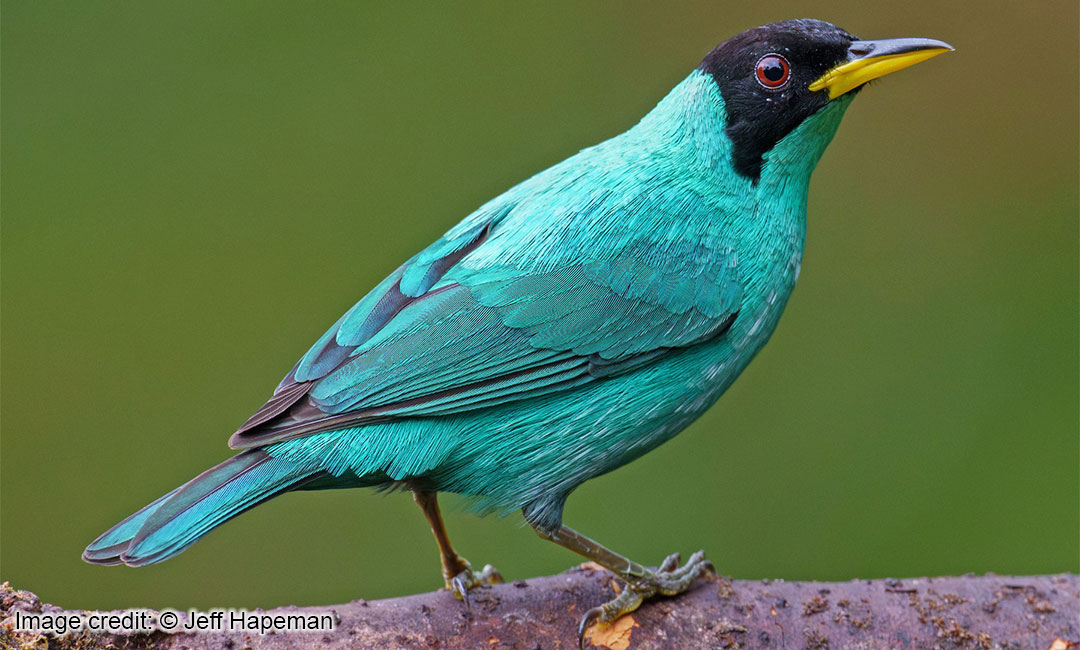
Green Honeycreeper
Scientific Name: Chlorophanes spiza
Very attractive small tanager of humid tropical lowlands. Found in humid evergreen forest edges, plantations, and gardens; at times with mixed-species feeding flocks of honeycreepers and euphonias. Often in pairs, feeding at all levels in fruiting trees and bushes. Note the short, curved bill. Males are a unique green-blue color with black hood and a banana yellow beak. Female resembles female Red-legged Honeycreeper but is larger, brighter, uniform green, with yellow lower bill and grayish legs.
Energetic and agile, this species moves deftly through the canopy, frequently hanging upside down to reach ripe fruit or probe flowers. It feeds mainly on small fruits, nectar, and occasional insects, using its curved bill with precision. Its soft, high-pitched calls help maintain contact within pairs or flocks as they travel together. Despite its vivid coloration, it can blend remarkably well into dense foliage. In Costa Rica, it is commonly seen in fruiting trees near forest edges and is a regular visitor to gardens with native plants.
More Species!
Get Your FREE Apps!
The following apps make it easy to record the birds you find and seamlessly link observations with global online databases of bird records used by hundreds of thousands of birders around the world. These free resources help you keep track of your birding activity while making your data openly available for scientific research, education, and conservation.
eBird Mobile App


Merlin Bird ID App
Request Your Experience
Newsletter Sign Up
Sign up for our newsletter to receive exclusive updates, special offers, and the latest news delivered straight to your inbox!
NAVIGATION